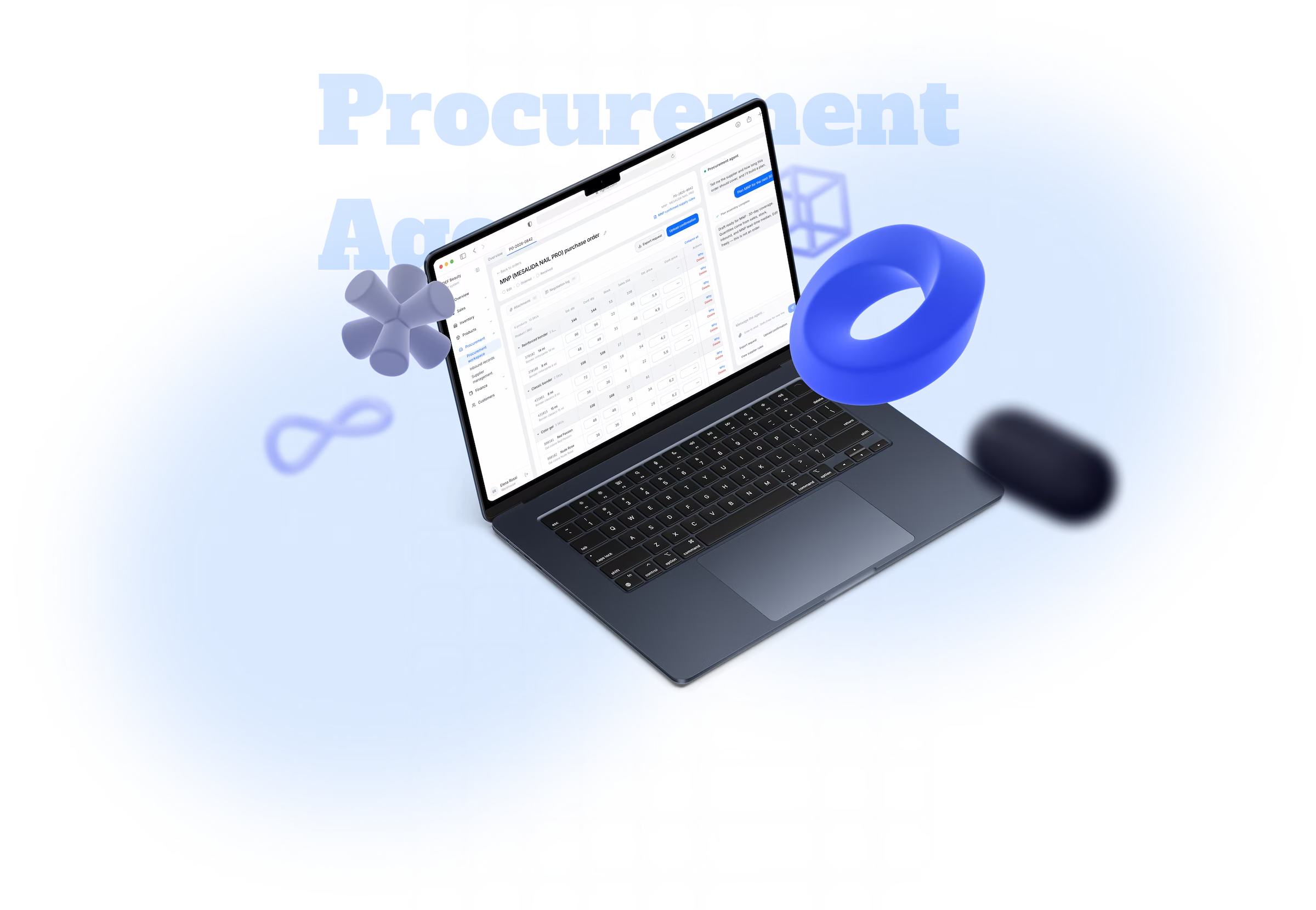
Excel broke data traceability.
AI Procurement Agent for DEF Beauty Supply
Designing AI to participate in the real purchasing workflow — starting from document comparison and exception flagging, while keeping judgment, decisions, and commitments under human control.
B2B SaaSEnterprise UXAX DesignAgent WorkflowFull stack
About DEF Beauty Supply
DEF Beauty Supply is a B2B beauty wholesaler serving professional customers in Italy. Its purchasing work was stuck on manual checking: compare the buyer's draft against the supplier confirmation, then compare delivery documents against that confirmation when goods arrive. I designed a workflow where AI flags discrepancies, and buyers judge what each difference means and what to do next.
Role
UX / AX Designer
End-to-end ownership from research through agent design and implementation.
Scope
Platform redesign → Procurement lifecycle → AI Procurement Agent
Team
Cross-functional collaboration with procurement, operations, and business stakeholders.
Company
DEF Beauty Supply
Year
2026
00 / Interactive Demo
01 / Context
The brief: add AI to fragmented B2B procurement.
DEF Beauty Supply's procurement work was spread across disconnected software, documents, messaging, and spreadsheets. Buyers spent time manually comparing purchase drafts against supplier confirmations, then comparing delivery documents against those confirmations when goods arrived — checking for typos, packaging changes, stockouts, missing shipments, or partial deliveries.
I started from that impulse — add AI to procurement — then discovered the real work was not building an AI feature, but making AI participate in the buyer's actual workflow, starting from those repetitive document comparisons.
02 / Old flow
The old path ran through Excel, estimates, and messages — purchase and fulfillment never shared one record.
Buyers downloaded sales and stock, estimated quantity in Excel, then confirmed with suppliers over WhatsApp and email. When goods arrived they searched SKUs one by one to stock in. Confirmation, DDT, and received quantities were compared by hand. The quantity decision stayed with the buyer; the system only recorded the final stock-in.
The old purchasing flow
01Inventory system
02Download sales & stock
03Excel
04Buyer estimates quantity
05WhatsApp / Email supplier
06Supplier confirms
07Goods arrive
08DDT
09Manually search SKU one by one
10Stock-in
Quantity decisions stayed manual.
Supplier messages lost purchase context.
Purchase and fulfillment had no shared record.
Receiving was re-entered by hand.
01
Fragmented data
Sales, stock, supplier communication and receiving lived in different tools.
02
No lifecycle
The system recorded stock-in, but not purchase intent or fulfillment state.
03
Manual reconciliation
Confirmation, DDT and received quantities had to be compared by hand.
Procurement data existed at every step, but the system could not connect those records into one decision and fulfillment lifecycle.
03 / Phase 1
Making procurement structured and traceable
While making procurement structured and traceable, I also looked at which manual parts AI could take — not to recommend what to buy, but to replace repetitive checking inside that lifecycle.
01 · OBJECT MODEL
Every receiving event belongs to a purchase lifecycle.
Instead of isolated inventory changes, receiving remains connected to the purchase that created it.
Purchase
Confirmation
DDT
Receiving
Inventory
02 · STATE MODEL
Each purchase moves through explicit, recoverable states.
Draft
Awaiting supplier
Confirmed
Ordered
Partially received
Completed
03 · EVIDENCE MODEL
Confirmation, DDT, and actual receiving remain linked instead of overwriting each other.
This makes discrepancies visible rather than hidden in the final stock value.
Purchase request
Supplier confirmation
DDT
Actual receiving
A shared purchase record connects estimated quantities, supplier confirmation, pricing, and order status. AI flags confirmation discrepancies visually in the table.
1 of 2
Adding AI for the sake of adding AI
The manual work that could move to AI was document comparison: buyer draft vs supplier confirmation (typo, new packaging, stockout), then DDT vs confirmation when goods arrive (missing vs partial shipment).
Differences showed as highlighting in the table and a reminder column. This was AI bolted onto a check, not a purchasing recommendation. It did not decide what to buy or how much.
04 / The Turning Point
There was no way to predict purchase quantity.
No way to give the buyer a purchasing recommendation.
Now I don't need to switch between Excel and the system anymore. But the part that takes the most time is still the same. I still have to decide what to buy and how much.
One example of lost context
I observed buyers used the last three months of sales to estimate quantities. The first design showed last-3-month sales on the SKU. But stockout signals were still lost. Buyers had to remember that themselves.
05 / Handoff
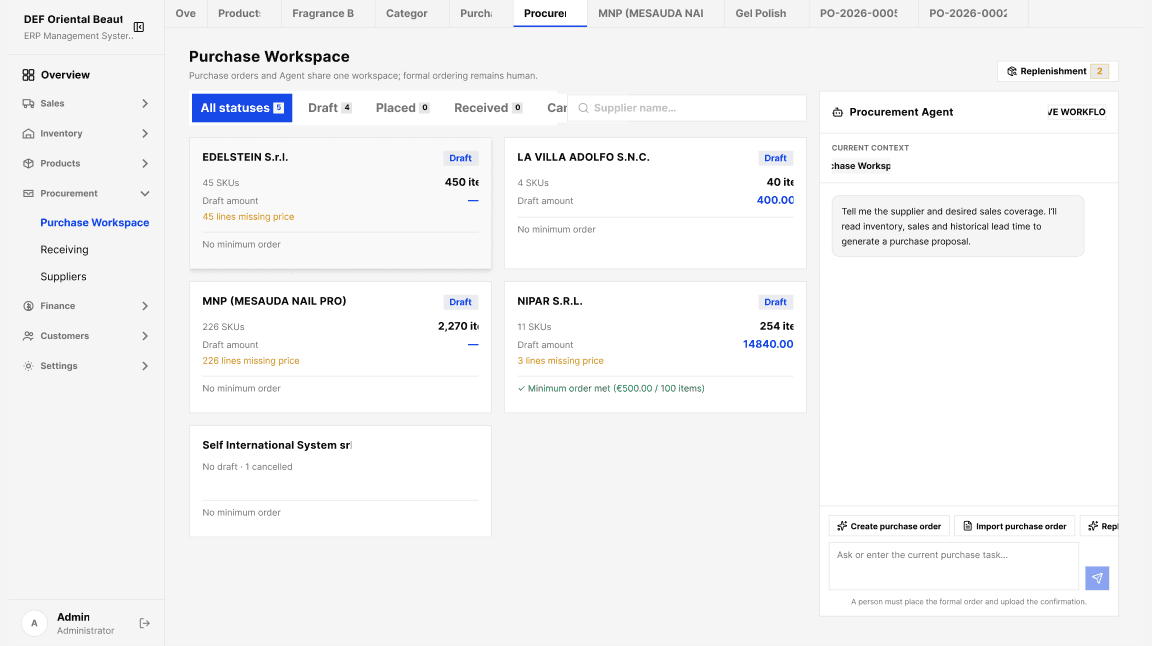
AI suggests and flags. The buyer sees every handoff and keeps the formal order.
Information architecture
Procurement Workspace
06 / Architecture
The LLM interprets. The engine calculates. The buyer decides.
I separated probabilistic interpretation from deterministic quantity calculation and human authorization so recommendations remained explainable and controllable.
Purchase decision
What to buy, how much, and when is assembled from evidence the buyer can inspect. The Agent keeps context; the buyer judges and places the formal order.
Rationale
Quantity affects cash, inventory risk, and supplier commitments, so the recommendation must be reproducible from business inputs, not generated probabilistically.
07 / Learning
Learning is governed. The Agent suggests updates; the buyer approves them.
Learning loop
Each time a buyer adjusts a recommendation, and each time actual delivery differs, that gap becomes a learning signal. The Agent can refine its next calculation — after the buyer reviews and approves those updates.
Learning is governed: the Agent suggests updates, the buyer approves them before they affect future calculations.
08 / Iterations
Testers thought the Agent already placed orders. The iterations made the handoff visible.
AI suggests, the buyer reviews and edits, the buyer places the order, exceptions return to the human.
ExplainInitiate
Conversation should initiate and structure real work, not merely explain the interface.
If buyers already knew what they wanted to do, explanation added little value. The Agent also asked for implementation-oriented inputs that could instead be derived from supplier history.
CompareRecommend
The Agent should reduce decision complexity while keeping its recommendation inspectable and reversible.
The buyer expected the Agent to do the comparison. Presenting several alternatives transferred the analytical burden back to the user and made the Agent feel indecisive.
AutomateHand off
Automation should stop where legal, financial, or external commitment begins.
Formal ordering happens externally through email, WhatsApp, or supplier channels. It creates real financial and supplier commitments, so the business would not delegate it to an Agent.
Separate approvalEscalate by exception
Escalation should emerge from evidence and risk, not from a parallel workflow created too early.
A normal order may only become risky after new evidence arrives. Approval is a state transition triggered by evidence, not a separate type of order.
Manual receivingReconcile & learn
Learning should come from the gap between recommendation, human decision, and real-world outcome, not from edits alone.
Real fulfillment is not linear. One purchase order may arrive in several shipments, and actual quantities may differ from both the confirmation and the DDT.
09 / MVP Boundary & Results
Validated a functional Agent-ready MVP. The Agent does not place real orders.
Using real records and a coded prototype, I validated the lifecycle, discrepancy handling, and the human gate before any supplier commitment.
After production use I would measure whether buyers keep the recommended quantity, and whether the Agent still stops when approval is required.
Scope
A coded workflow with a shared plan-and-conversation workbench. The Agent never places the formal order.
10 / Next & Reflection
What I would do next — and what this changed about how I use AI.
What to do next
01
A trust score per supplier
Sales velocity and restock frequency differ by supplier, so the Agent does not mature at one speed. Score each supplier. Turn automation on only after that score is trustworthy enough.
02
Purchase reminders
Predict when to buy from product sales, supplier lead time, and whether the order will hit a free-shipping threshold. Remind the buyer before the gap becomes urgent.
Reflection
01
Started from AI for the sake of AI
I looked at which manual checks AI could take: draft vs confirmation, then DDT vs confirmation.
02
Isolated checks were not enough
They could flag diffs, but they could not give the buyer a purchase-quantity recommendation.
03
The Agent had to join the workflow
To reduce the cognitive work, context stayed in the flow. AI flags and drafts; the buyer judges and commits.